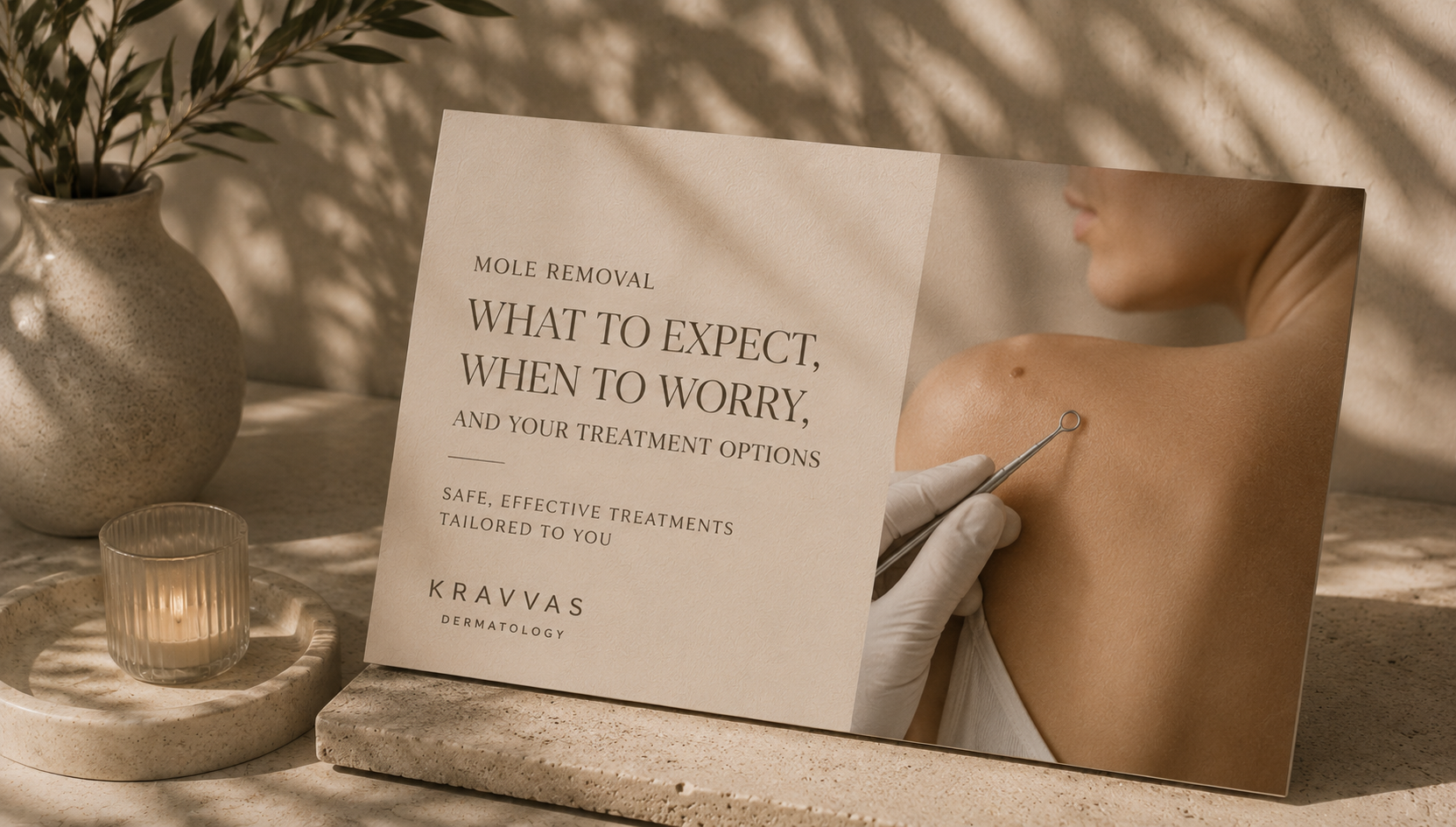
Moles are extremely common and, in most cases, harmless. However, some moles can change over time, become irritated, or raise concerns about skin cancer. Others may simply be cosmetically unwanted or uncomfortable due to their location.
The good news: modern mole removal procedures are usually quick, safe, and performed under local anaesthetic, with techniques tailored to both medical safety and cosmetic outcome.
Moles, also called naevi, are collections of pigment-producing cells known as melanocytes. They may be present from childhood or develop gradually over time.
Moles can vary significantly in appearance. They may be:
Most moles remain stable throughout life, but some can evolve over time due to age, sun exposure, hormonal changes, or other skin factors.
Certain changes can indicate abnormal activity and, in some cases, melanoma skin cancer.
Warning signs include:
Dermatologists commonly use the ABCDE rule:
If you notice any of these changes, arrange a professional skin assessment promptly.
Not all mole removals are medically necessary. Patients commonly seek removal because a mole is:
Facial moles, neck moles, scalp moles, and raised body moles are among the most commonly treated.
The best treatment depends on the type of mole, its location, and whether there is any concern about skin cancer.
This is the gold-standard method for suspicious or deeper moles.
The mole is fully removed under local anaesthetic together with a small margin of surrounding skin. The wound is then closed with stitches.
This technique allows the tissue to be sent for histology testing where needed.
For benign raised moles, shave removal may provide an excellent cosmetic result.
The lesion is carefully shaved flush with the skin surface under local anaesthetic. Healing is usually straightforward, although some moles can recur over time.
Laser treatment may occasionally be suitable for certain superficial benign lesions, although it is generally not recommended for suspicious pigmented moles because tissue cannot be analysed afterwards.
A dermatologist assessment is essential before considering laser treatment.
Most mole removals are straightforward outpatient procedures performed in clinic.
This usually includes:
Most appointments take around 20 to 45 minutes depending on complexity.
Patients can usually return to normal activities shortly afterwards.
Any skin procedure can leave a scar, but careful surgical technique and appropriate aftercare significantly improve cosmetic healing.
Scar appearance depends on:
Protecting healing skin from sun exposure is particularly important during recovery.
Sometimes partially removed moles can recur, especially after shave removal rather than complete excision.
If pigmentation reappears within a scar, it should always be reassessed by a dermatologist.
The procedure itself is usually very well tolerated because local anaesthetic numbs the area beforehand.
Suspicious moles are commonly sent for histology testing to rule out skin cancer.
Yes. Many patients choose mole removal for cosmetic or comfort-related reasons.
Some scarring is always possible, but dermatologists aim for the best cosmetic outcome possible, particularly on the face and neck.
Initial healing usually occurs within 1 to 3 weeks, although scars continue improving over several months.
When performed by an experienced dermatologist, mole removal is generally very safe and effective.
If you are concerned about a changing mole, irritated skin lesion, or you are considering cosmetic mole removal, book a consultation with Dr. Kravvas on Harley Street. Following a full skin assessment, treatment options can be discussed with careful attention to both medical safety and cosmetic outcome. (This article is general information and not personal medical advice.